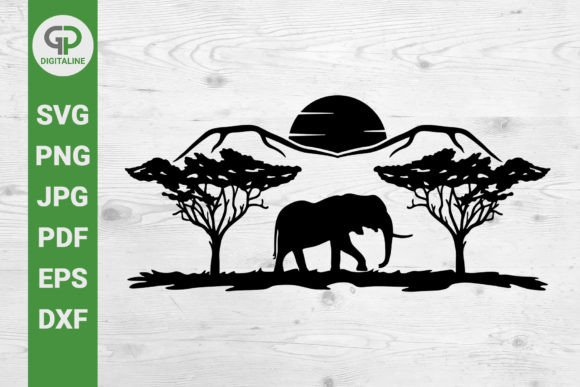
Desert Elephant and Sunset in Africa SVG
A First Stitch Through the Savannah
When I opened Desert Elephant and Sunset in Africa SVG, I didn’t just see an illustration—I saw a story waiting to be stitched. The composition immediately evokes warmth, stillness, and quiet grandeur: a strong-profiled elephant centered against layered hills, an acacia tree anchoring the left side, and a soft gradient sunset bleeding across the top third. It’s not overly busy, but it’s not minimalist either—it lands right where most embroidery designers want it: detailed enough to feel intentional, open enough to breathe under thread.
This Isn’t Just a Graphic—It’s a Finished Product in Waiting
I tested Desert Elephant and Sunset in Africa SVG on a natural linen tote bag for a local boutique client. Why? Because that’s where this design shines—not as a standalone digital file, but as part of a cohesive handmade product. The silhouette of the elephant reads clearly at 4.5 inches wide, the acacia branches hold their shape without fraying, and the hill contours translate beautifully into gentle fill-stitch gradients. Customers paused mid-aisle to touch the stitching. That tells me something important: this design carries presence. It doesn’t shout; it invites.
Where It Stitches Best (and Where It Asks for Extra Care)
Desert Elephant and Sunset in Africa SVG works especially well for:
- Sweatshirt embroidery—the bold outlines and moderate detail hold up on fleece and French terry without overcrowding;
- Embroidered patches—its balanced negative space makes clean edge cutting easy;
- Baby embroidery—on organic cotton onesies or muslin blankets, the gentle scale and nature theme read as soothing, not overwhelming;
- Holiday or wedding gifts—think monogrammed tea towels or pillow covers for safari-themed baby showers or anniversary keepsakes;
- Etsy seller listings—it layers cleanly into printable mockups and pairs well with neutral palettes in product photos.
But—and this is where experience matters—Desert Elephant and Sunset in Africa SVG needs thoughtful placement on certain substrates:
- Avoid tight hoop sizes under 5x7 inches unless you’re willing to simplify key elements like distant hills or fine acacia twigs;
- On thin or stretchy fabric (like lightweight jersey or rayon challis), use cutaway stabilizer and reduce stitch density slightly—those sunset gradients can bunch if overfilled;
- Dark fabric demands careful thread color testing: warm golds and burnt oranges pop, but pale yellows disappear. Always run a black-and-white mockup first;
- Caps and curved surfaces compress the upper landscape—consider cropping the top 15% of the SVG before digitizing for headwear;
- For frequent-wash items (kitchen towels, baby bibs), confirm whether the original vector includes separate layers for satin-stitched outlines versus fill areas—this affects durability.
Design Integrity Meets Commercial Practicality
As a designer who ships embroidered goods to clients across three continents, I pay attention to how a graphic translates from screen to stitch to shelf. Desert Elephant and Sunset in Africa SVG holds its own: the elephant’s trunk has subtle curvature—not so much that it threads poorly, but enough to feel alive. The acacia tree isn’t just a cluster of dots; its branching structure guides the eye naturally. That kind of visual logic builds trust. When customers see this on a custom apron or nursery pillow, they don’t think “generic clipart.” They think “thoughtfully made.”
That perception directly lifts perceived value. A small shop owner told me she doubled her price point on sweatshirts featuring this design—not because she changed the product, but because customers consistently described it as “gallery-worthy.” That’s the power of cohesive Illustrations that respect embroidery’s physical limits.
Real Designer Notes Before You Stitch
Before using Desert Elephant and Sunset in Africa SVG in your next embroidery project, here’s what I do—and recommend you do too:
- Test on scrap fabric first, especially if pairing with textured weaves or blends;
- Check thread color contrast across at least three fabric tones—light, medium, and dark;
- Review stitch density visually: zoom into the hills and sunset area—if fills look muddy or overly dense, adjust underlay or reduce density by 5–10%;
- Confirm hoop size compatibility—this is a landscape-oriented design, so horizontal hoops often work better than square ones;
- Inspect small details at actual stitch size: those acacia leaves should read as texture, not static noise;
- Try a black-and-white mockup to assess silhouette strength—great embroidery files hold up even without color;
- Compare light and dark background renditions—some sunset gradients lose definition on black fabric unless adjusted;
- Use proper stabilizer: medium-weight cutaway for stable fabrics, tear-away for stable cottons, and hybrid for knits;
- Verify licensing terms before selling finished products or bundling the SVG into digital embroidery kits—since it’s labeled as a Graphics asset, commercial use may require attribution or a separate license;
- Ask yourself: does this support my brand voice? If your craft business leans modern-minimal, this design adds warmth without clutter. If you specialize in hyper-detailed wildlife, you might layer it with hand-embroidered accents—but don’t force complexity where simplicity already works.
Final Thought: This Design Earns Its Place
Desert Elephant and Sunset in Africa SVG isn’t flashy. It doesn’t try to be everything. But it does one thing exceptionally well: it turns quiet moments—the hush before dusk, the weight of memory, the calm of wild things—into tangible, stitchable meaning. Whether you’re embroidering a holiday gift for a friend, building inventory for your Etsy shop, or designing a signature line for your small shop product, this is the kind of Illustration that feels earned, not added. It belongs—not because it’s trendy, but because it stitches true.