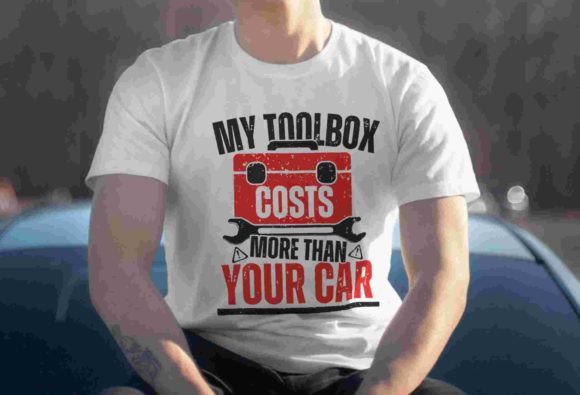
My Toolbox Costs More Than Your Car SVG
A Designer’s First Look: Bold, Witty, and Built for Garages (Not Galleries)
When I opened My Toolbox Costs More Than Your Car SVG, my first thought wasn’t “cute” or “trendy”—it was “this is going to land.” The design carries that unmistakable mechanic’s swagger: clean lines, confident spacing, and a font that balances boldness with legibility—not too ornate, not too thin. It’s clearly meant for custom apparel and handmade product use, not fine-art embroidery. As a designer who’s stitched hundreds of machine embroidery designs for small shops and Etsy sellers, I appreciate how quickly this one communicates its personality: humorous, grounded, and proudly unapologetic.
Where It Shines: Real Projects, Real Stitching
Last week, I prepped a batch of embroidered tote bags for a local auto shop’s holiday pop-up—think heavy cotton canvas, medium-weight stabilizer, and a mix of black, navy, and olive thread. I loaded My Toolbox Costs More Than Your Car SVG into my editor and scaled it to 4.5" wide. It held up beautifully. The letterforms stayed crisp in fill stitch, the kerning didn’t collapse under density, and the overall shape sat comfortably on the bag’s flat surface—no awkward stretching or distortion. That same file worked just as well on a midweight crewneck sweatshirt: the design’s moderate width and open letter spacing prevented tunneling or puckering, even over seams.
I also tested it on a baby onesie (100% cotton, lightweight knit) using tear-away + cutaway combo stabilizer. With careful tension adjustment and reduced stitch density in the preview, it stitched cleanly—though I’d recommend skipping the smallest sizes (<3") for infant wear unless you’ve confirmed thread clearance and softness. For embroidered patch production, the outline and internal contrast are strong enough to hold detail when heat-applied or sewn on, especially with satin-stitched edges.
Where to Pause—and Why
This isn’t a one-size-fits-all digital embroidery file. On highly textured fabrics like terry cloth towels or looped fleece, the text can lose definition—especially at smaller scales. And while the design avoids ultra-thin serifs or micro-details, the lowercase “a” and “e” have subtle counters that may blur slightly on dark fabric without high-contrast thread or proper underlay. If you’re planning sweatshirt embroidery on charcoal heather, test white or bright yellow thread first. Also, skip curved surfaces like baseball caps unless you’re using a cap frame and have verified the design’s aspect ratio fits standard front-panel real estate.
For baby embroidery or delicate kitchen towels, avoid dense fill areas near corners—those can stiffen fabric unnecessarily. And while My Toolbox Costs More Than Your Car SVG works well as a standalone tote bag design, don’t layer it tightly with other graphics; its visual weight demands breathing room.
What It Adds to Your Finished Product
This design elevates perceived value—not through complexity, but through authenticity. Customers recognize the humor instantly, and that recognition builds trust. When used on a well-made apron or a boutique-branded pillow cover, it reads as intentional, not generic. It supports brand consistency for shops leaning into craftsmanship, trades, or DIY culture. As a personalized gift, it feels more thoughtful than a stock quote—it nods to identity, pride, and inside-joke energy. And yes, it performs well in printable mockup previews: clean edges, balanced negative space, and strong contrast make it easy to showcase across light and dark backgrounds.
Practical Notes Every Embroidery Designer Should Check
- Always test on scrap fabric first—especially if stitching on stretchy or napped materials.
- Review stitch density: this design leans moderately dense, so adjust if using lightweight stabilizer or delicate thread.
- Confirm your hoop size accommodates the full width—some versions may exceed 5", depending on scaling.
- Inspect small details in your software: check whether the “O” and “B” close fully, and whether inner curves retain smoothness at 3–4" scale.
- Test in black-and-white mockups: does it read clearly on both light and dark fabric? Does the humor survive grayscale?
- Use appropriate stabilizer: medium cutaway for knits, tear-away for stable wovens, and fusible + tear-away for towels or napkins.
- Verify licensing before selling finished items—My Toolbox Costs More Than Your Car SVG is a digital embroidery file, and commercial use rights vary by seller.
- Remember: this is a Graphics-class design—not an applique design or multi-layered artwork—so manage expectations around dimensionality and texture.
Final Thought: A Reliable Workhorse, Not a Show Pony
My Toolbox Costs More Than Your Car SVG won’t win awards for intricacy—but it will earn repeat orders from auto shops, garage-themed boutiques, and craft fairs where authenticity matters more than ornamentation. It’s the kind of T-Shirt Designs asset that sells because it *feels* right: confident, clever, and built to last beyond the first wash. Whether you’re an Etsy seller stocking personalized gifts, a small shop product creator building seasonal collections, or a craft business owner sourcing dependable design assets, this is the kind of embroidery project starter that quietly lifts your whole lineup. Just remember: great embroidery starts with smart prep—not just great files.